
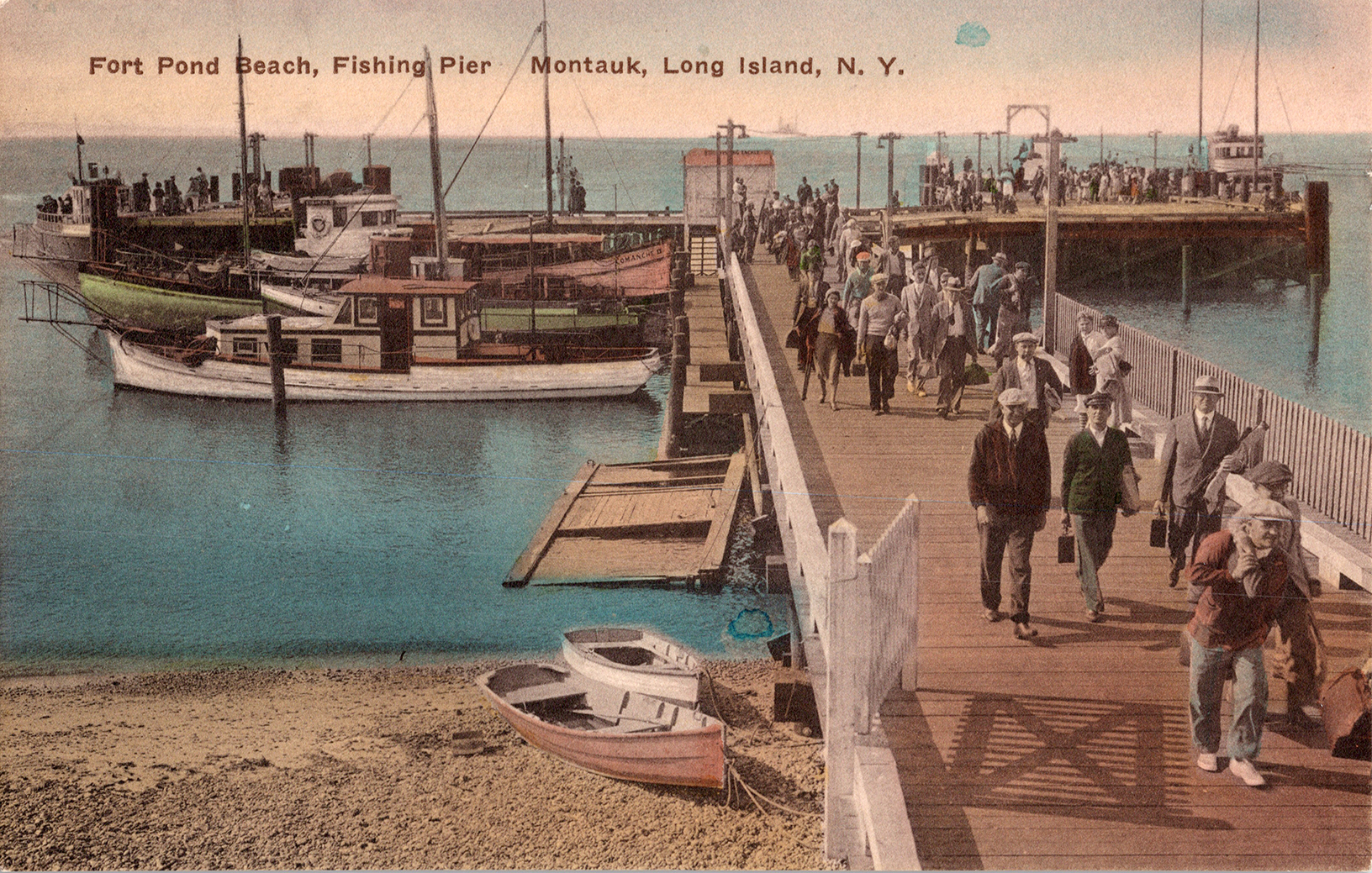
Either the people on this dock are going home pitifully empty-handed after a fishing trip, or else they have just landed in Montauk on a ferry after visiting New York or New London.
We think it’s the latter, and that the era could be the 1920s, when the Montauk Steamboat Company and then its successor, the Montauk and New London Steamboat Company, were running passenger ferries between Fort Pond Bay, New England, and New York City.
It’s not clear who built this sturdy ”fishing pier” at “Fort Pond Beach” or when they did so. In the East Hampton Star, the late Rusty Drumm riffed about the various entities that had poked out into the bay throughout the 20th century and even earlier:
“Piers, docks, quays, whatever you choose to call them, Montauk’s Fort Pond Bay has had many over the years. They were built to accommodate commercial fishermen, to test torpedoes, to disembark soldiers, Cunard Line passengers, and more than a few cases of bootlegged booze. One even allowed railroad cars to put to sea.” (The latter being the Union News Dock, where commercial fishermen could load catch directly onto railroad cars bound for New York.)
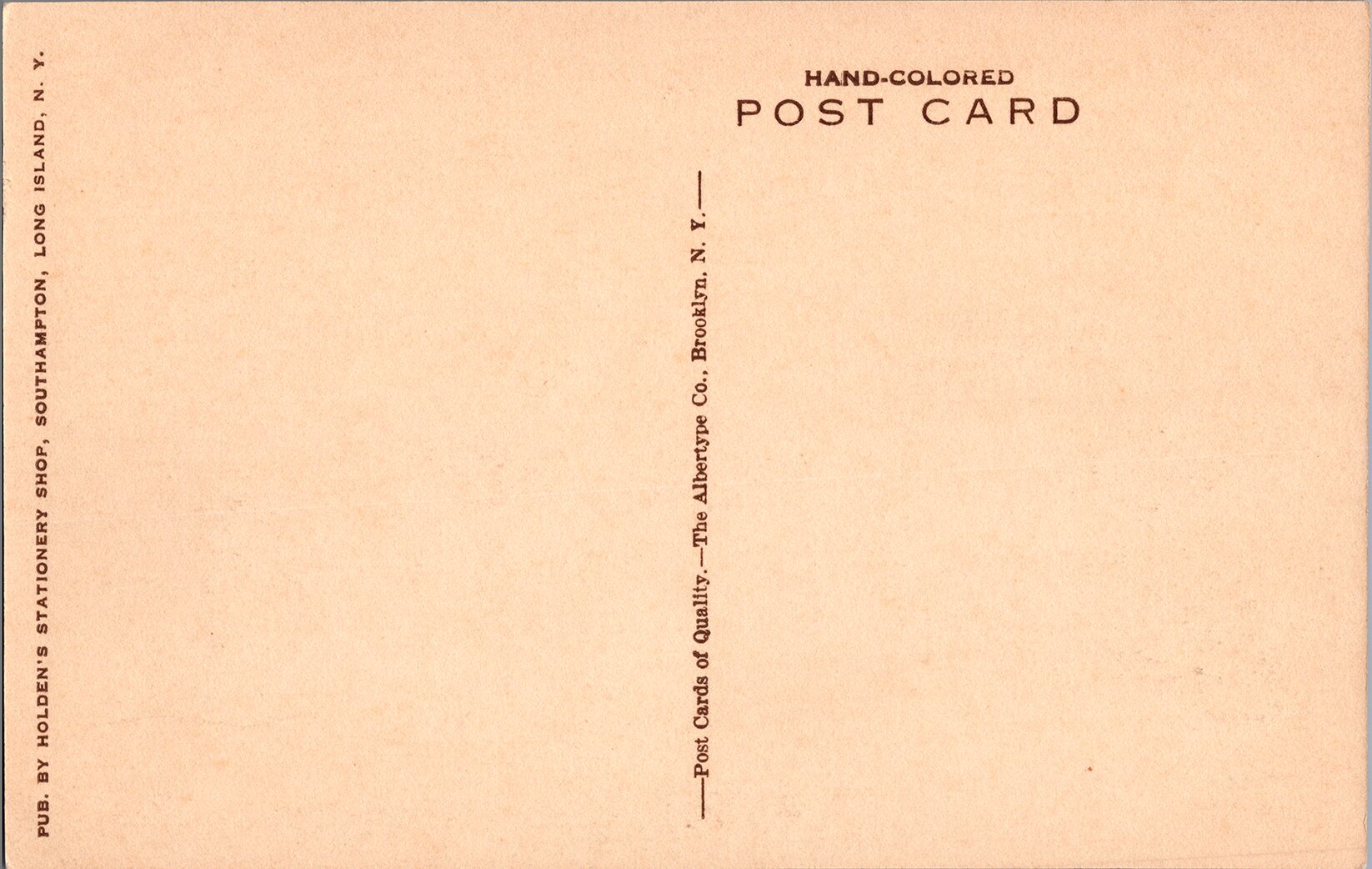
The reverse side of the postcard (it’s divided, meaning it was printed after 1907, when the U.S. Postal Service started to allow correspondence as well as addresses on the back side) has the words “Post Cards of Quality – The Albertype Co., Brooklyn, N.Y.”
Founded in 1890 by Adolph and Herman L. Wittemann, the Albertype Company was named for a photo printing process invented by Joseph Albert, a German photographer, and it produced more than 25,000 postcards and souvenir books over a 60-year run. Small changes over the years help collectors – especially of the company’s prized Babe Ruth cards – pinpoint the date of their publication: the words “Post Cards of Quality” were introduced in 1907, for example, while the words “Albertype Co.” over time morphed into “The Finest American Made View Post Cards.”
The company began making hand-colored versions of their postcards in the 1920s, according to a vintage seller’s blog, Collectible Ivy. “A Brooklyn Daily Eagle article from 1939 says that the company’s factory had a ‘room in which 20 or more girls were feverishly working on cards,’” most of which were headed for drugstore racks. The blog also cites a 1946 classified ad for “airbrush girls.”
The library’s postcard of the Fort Pond Bay fishing pier is just one of very many that are currently being digitized to more easily share with viewers.
“Albertype’s products are an invaluable resource for the historian who is interested in the late 19th and early 20th century,” the collectibles blogger says. “They provide real historical context and their images truly are worth a thousand words.”
Reply or Comment