
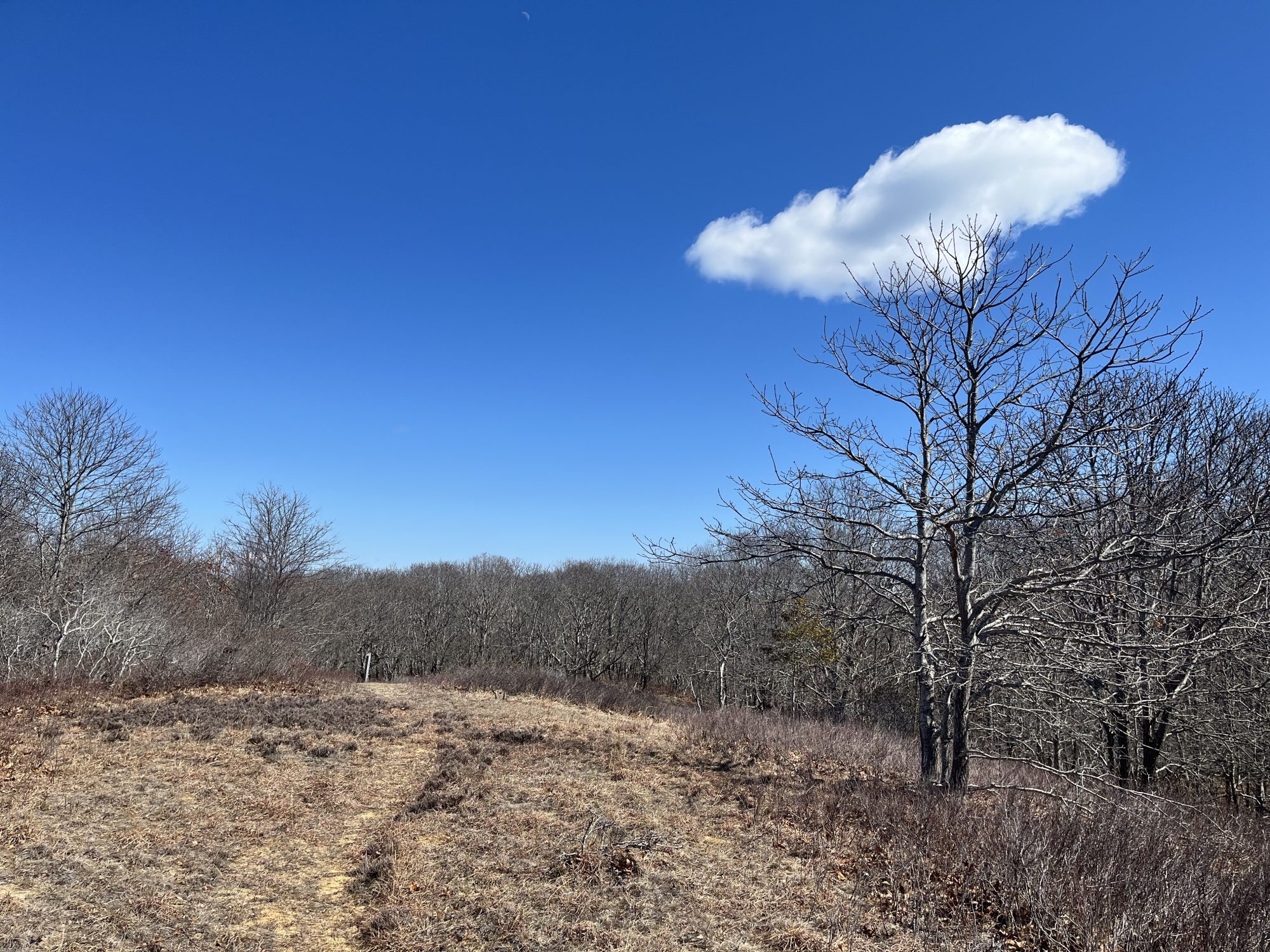
Nestled within a residential area off Second House Road, one of the few maritime grassland remnants in New York persists. Montauk Mountain Preserve is a modest 11-acre parcel rich in history and biodiversity. The Nature Conservancy has preserved it through a series of acquisitions and donations made in the 1980s and 1990s.
A .5-mile trail meanders through the preserve, which, if you follow it clockwise, begins with an abrupt ascent through an oak-dominant forest. The trail opens into a small grassland community shaped by salt spray and strong onshore winds, then twists downhill past encroaching shadbush, oaks, and cherry trees, once managed by the grazing and fire practices of early settlers and Indigenous Montauketts. The remaining grassland at the mountaintop, fragmented from the once-dominant habitat, provides a lens into Montauk’s moorland past.
“For miles one sees nothing but rolling hills, deceptive as to size and the depth of the kettleholes between them, mostly bare of trees, from the easterly edge of Hither Woods to just east of Great Pond,” wrote botanist Norman Taylor in his 1923 exploration of the flora of the area, The Vegetation of Montauk: A Study of Grassland and Forest.
“Despite their small size, maritime grasslands in New York still support some of the rarest plants,” said Dr. Robert E. Zaremba of the Nature Conservancy in the Long Island Botanical Society Newsletter. Botanists like Zaremba studied Taylor’s 1923 work to develop a picture of the changing coastal landscape and the threats to the remaining maritime grasslands.
Montauk Mountain Preserve is home to rare plants like the New England blazing star, Nantucket shadbush, and bushy rockrose.
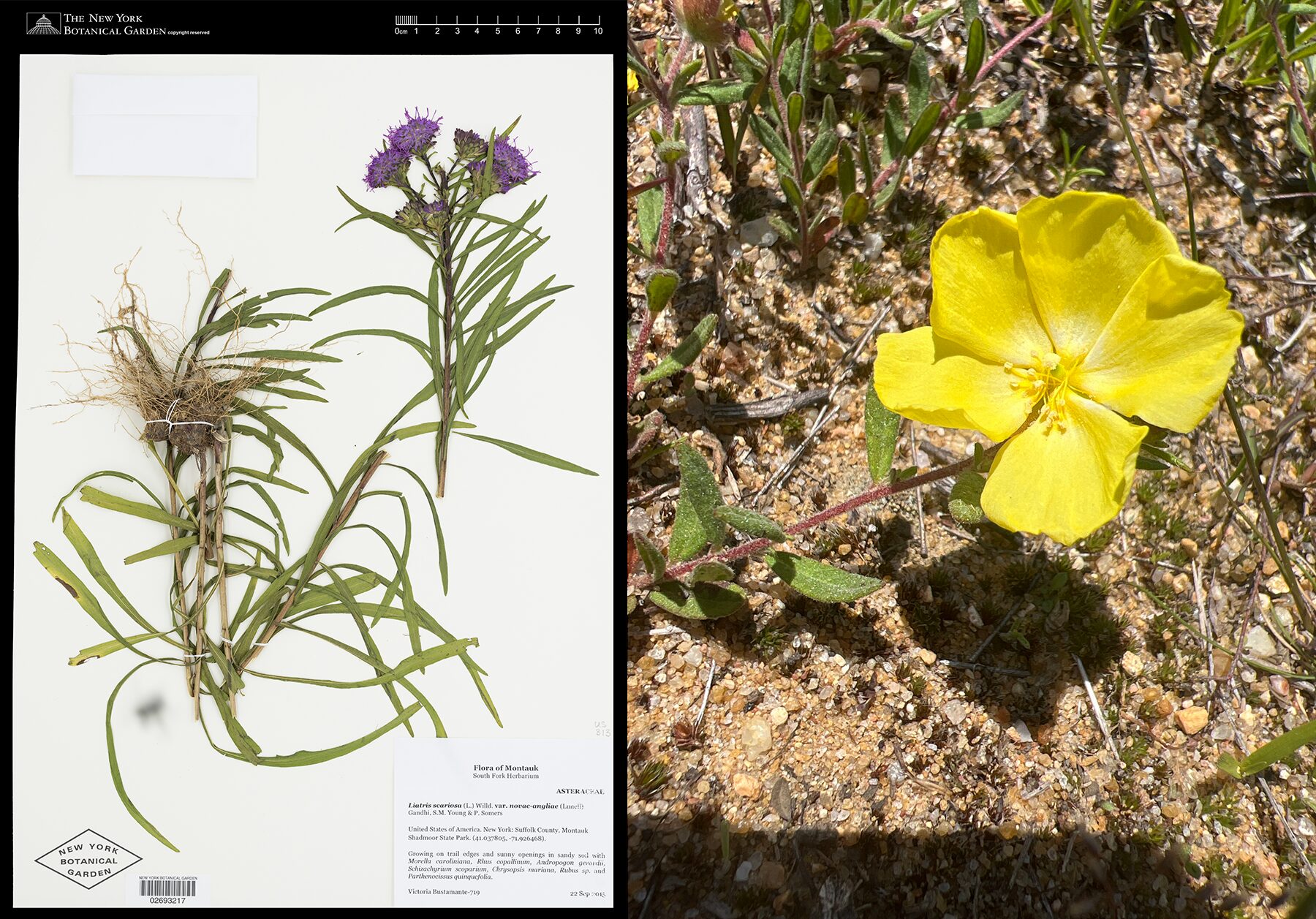
Zaremba called bushy rockrose (Helianthemum dumosum) the “signature species” of the maritime grassland, for its yellow flowers are always present in healthy examples of the habitat from the Hempstead Plains in western Long Island to the far eastern hills of Cape Cod, Massachusetts, where he botanized.
“Their preferred habitat, the heathland, has lost a lot of ground to development and succession – the shift in plant growth to shrubs and thickets” reported Virginia Garrison in the East Hampton Star in 1988 when the Nature Conservancy established the New York Natural Areas Registry, an initiative to educate landowners about rare species and encourage them to become environmental stewards of the flora and fauna on their land.
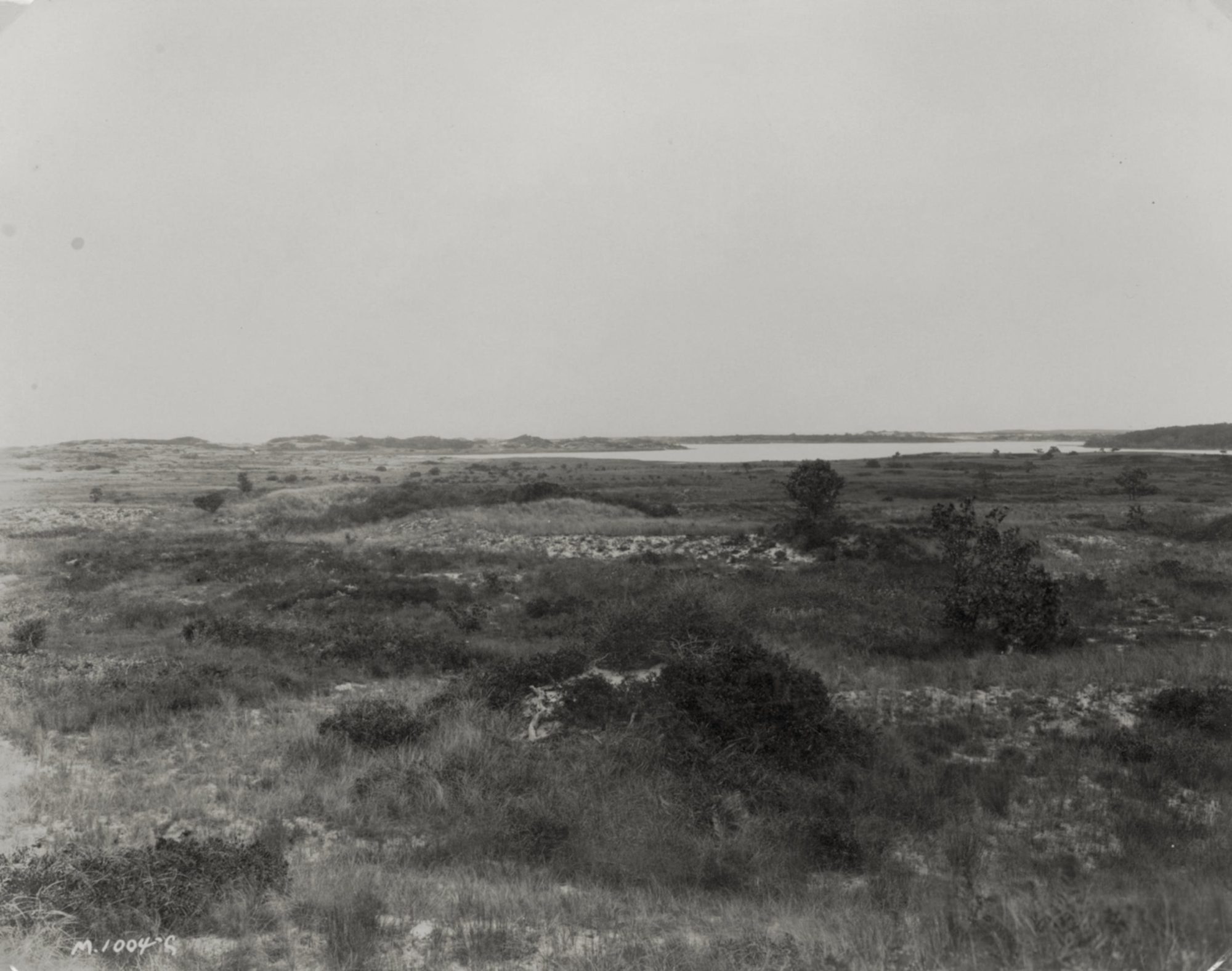
Montauk’s once proliferating grasslands made it ideal pasturage for cattle and sheep driven from East Hampton and Amagansett. At the time of the American Revolution, there were about 2,000 cattle and 4,000 sheep grazing unprotected in the fields of Montauk, save for their keepers who lived at First House, Second House, and Third House. The open rolling hills of Montauk and their proximity to the sea made the livestock not only visible as they grazed the hillsides, but also vulnerable to pillage by British fleets occupying the waters off New England and Long Island.
On March 17, 1776, word reached East Hampton of a possible attack on Long Island. After a series of threats and nearby plunderings of livestock from Fisher’s Island, guards were stationed on Montauk to protect cattle and sheep. Captain John Hulbert of Bridgehampton took a small army of 69 men to Montauk, but after “seeing the size of the enemy fleet off Montauk Point decided that their own numbers were insufficient, wrote Henry Osmers in American Gibraltar: Montauk and the Wars of America.
Captain John Dayton of the First Regiment of Minutemen in Suffolk County assembled a group of forty local farmers to protect the livestock and devised a plan to create an impression that more soldiers were stationed on Montauk than actually were.
Dayton and his men hiked up a hill, purportedly Montauk Mountain, in clear view of the British fleet moored off Fort Pond Bay. They marched over the hill and descended into a hollow. Out of sight from the British fleet, they turned their coats inside out, marched back through the hollow to the base of the hill, and ascended in line again repeatedly to appear as if a “large army were marching and encamping in the vale below.”
Whether this maneuver––known as the “turncoat incident” or “Dayton’s ruse”––was the cause or not, the British did not end up invading Montauk at that time and instead plundered Gardiner’s Island, which only had three inhabitants.
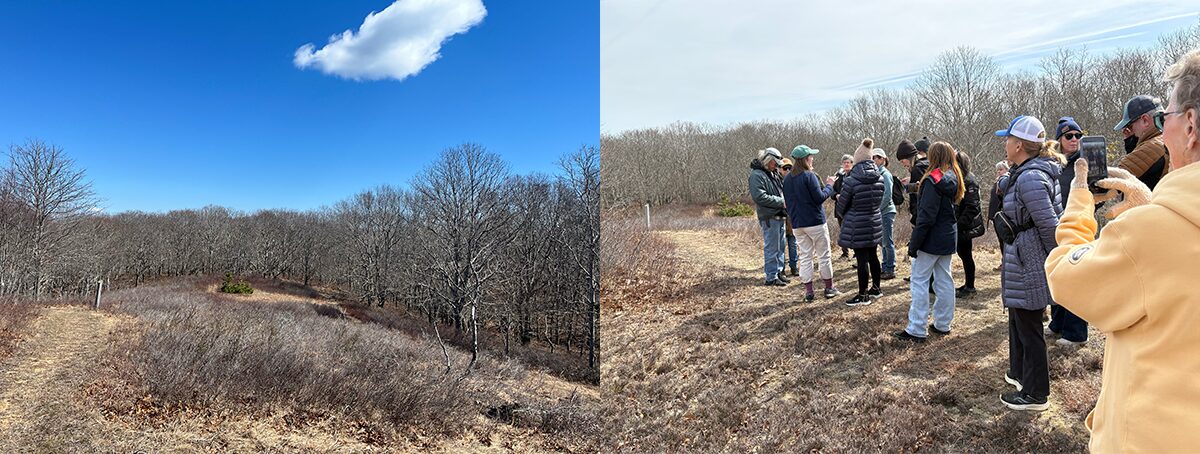
Montauk Mountain is open to the public from dusk to dawn. You can park in the small parking lot just off Second House Road and follow along this historic trail at your own pace. Happy trails!
Reply or Comment